

Showing posts with label fall. Show all posts
Showing posts with label fall. Show all posts
Thursday, October 24, 2013
Color coordinated


Sunday, September 29, 2013
Spectacular September morning
Yesterday's rain has given way to a sunny Sunday at sillydoggarden.


 Top to bottom: Front yard with colorful pear. Backyard with pink celosia. An unexpected, natural garden ornament. Back bed with dark burgandy-black ninebark. Steam rising from the deck.


Saturday, October 1, 2011
Dinner, together

A grouse is almost too heavy to balance on a stem of this viburnum while a chipmunk hangs upside down to grab his share of berries. Below: The berries.
The viburnum at the end of the driveway became a popular dining destination earlier this week. The shrub, Viburnum dentatum Red Feather, was loaded with blue-black berries -- until they were discovered by the birds, including this grouse, and the chipmunks.

The shrub is a good choice for our garden. It doesn't need a lot of coddling, always a happy attribute around here. In spring, the emerging foliage is maroon and because of some prominent veining, the young leaves themselves look something like feathers. White flat-top flowers follow. The berries arrive in fall as the foliage begins to turn purple.
Thursday, November 19, 2009
Golden children of autumn

The larch tree was in glorious form a few weeks ago. Today its soft, golden needles are gone.

Witch hazel begins blooming in October when most other shrubs and perennials are done or nearly done.
As autumns go, this one is more muted than others. Oh sure, there has been some color but it was shortlived, cutting out long before it should have. Blame it on the sodden, gray, cold October -- the foliage seemed to give up early, calling it quits before the reds, yellows and bronzes were fully developed and dropping quickly into swaths of brown leaf litter. Still, there were a couple of bright spots -- the larch, or tamarack, and the witch hazel. Both are worthy choices in the northern landscape.
Our best representative of the native American larch (Larix laricina) has settled in nicely at the end of the driveway. It's a good companion for the trio of black spruce, also native here. Both species like it boggy and are happy in the low area where they were planted. Larch is a crazy conifer, bearing cones but also shedding its soft needles in fall like a deciduous tree. Because this one is sited next to the spruce, its bright gold contrasts sharply with the green of the spruce. It punctuates the season like a giant exclamation point. It! Is! Autumn! Enjoy!
Witch hazel is another one of the kinda crazy relatives in the plant kingdom. Native witch hazel, Hamamelis virginiana, starts blooming in October when much of the rest of the garden is easing into dormancy. The threadlike petals look like miniature party streamers. You have to look closely, not only are the flowers small, they start blooming when the shrub still has leaves, making them somewhat difficult to see if you're not paying attention. Witch hazel has attractive leaves, attractive bark and attractive form. And it has history, having been used by American Indians for hundreds of years to treat cuts and bruises as well as colds and coughs.
Medicinal plant expert Steven Foster says the shrub was a favorite "witching stick" of dowsers searching for water in colonial America. It has nothing to do with witches but comes from the old English word for pliable branches "wych". I've never used witch hazel although I have seen it recommended for use as an astringent or to soothe insect bites.
Even in autumns when color runs rampant across the landscape, larch and witch hazel are notable for their contributions. And in a fall like this one they're appreciated even more.
Sunday, November 8, 2009
Season opener ... and closer

It may look like they're confused, but these crocus are blooming right on schedule in November.
It was just six months ago that I was trumpeting the arrival of spring's first crocus. Now, in November, I'm all agog over its fall-blooming cousins. Symmetry in the garden, whether through time or space, is a pleasing concept and the little crocus supplies it in a big way. How many other plants can herald the start of gardening season and announce its end as well?
To my eye, crocus are among the most graceful of flowers. They show up in spring when most of the rest of the world is still brown. And they show up in autumn, when much of the world is turning brown again. It's a perfect fit on either end of the seasonal spectrum. Most of us are so conditioned to crocus as a spring flower that seeing its familiar form in the fall is enough to turn heads. The first time I saw fall-blooming crocus was in Washington state. I was driving down a street in a tiny town near Fort Lewis when I saw a line of purple shooting up through fallen autumn leaves that were piling up against an iron fence. I had to stop the car and look -- such is the power of surprise in garden design.
I planted a few fall-blooming crocus some years back in a thicket of lingonberry and in a patch of low-growing, creeping veronica ('Waterperry blue'). They're beautiful, but really, I should have planted at least 20 times as many. Like many small bulbs, they show best when planted in large numbers.
This fall, I planted about 75 fall-blooming crocus -- some by the stairs to the deck in a bed of pussytoes and some by the reflecting pool. (I've nicknamed those by the pool as "doe crocus.") I thought I was planting purple Crocus speciosus, but now, after examining the blooms for several days, I'm wondering if the supplier mixed up the order and sent 'albus' instead. I'm not seeing any purple, and what I am seeing seems to fit the catalog description: "A pure white form of C. speciosus with pointed segments and a yellow throat." It's not a major issue -- they're still lovely and I'll simply order more of the purple fall-bloomers next year.


A purple crocus pokes its head out of a patch of lingonberry. (The bronze-red plant is a hardy geranium seedling.)

A delicate close to the season.
Saturday, October 10, 2009
October weather rant
This is what we woke up to this morning. Need I say more?
 At least the silly dog enjoys the first snow of the season.

 Salvia 'Victoria' huddles under the "dusting" of snow that last night's forecast warned us about.
 At least the silly dog enjoys the first snow of the season.

The pear's foliage contrasts with a carpet of white.
 Salvia 'Victoria' huddles under the "dusting" of snow that last night's forecast warned us about.
Friday, October 2, 2009
Summer in September swan song
The sunny, warm disposition of September has given way to an October so far marked by wind, clouds and rain. Only a few days ago we were enjoying a perfect autumn day. What makes such a day?
Asters so heavy with bloom they can barely keep their heads up and have to lean on the phlox.

Mums in full glory.

So many onions harvested the aroma wafts across the garden.

Sweet corn and shallots (in the stack of trays on the right) are harvested, too. Every year we wonder whether we'll get sweet corn here. And every year we have a respectable harvest. Even when the corn is knocked flat (remember August).

A flock of sandhill cranes flying across the clear blue sky. (Are they heading to Nebraska?) And a couple of late roses floating in a bowl by the bed. And a supper of corn chowder made with freshly harvested corn and potatoes.
And a box of bulbs arriving in the afternoon -- including fall-blooming crocus and a selection of spring-blooming tulips. Gardeners always look ahead.

Thursday, September 24, 2009
Lily porn
Fall is sneaking in the back door during this summery September -- it's time to review notes, evaluate performances and think about planting spring and summer blooming-bulbs. Lilies are at the top of the list.
1. These are Casa Blanca lilies, a garden classic. Beautiful clear white that only gets more lovely as the sun goes down. Graceful form. Nice fragrance. Tall, sturdy stems. Unfortunately, the deer also favor them. Last year, we didn't get any blooms because of the deer. This year, we doubled up on protection, caging them for much of the growing season and using the motion-detecting sprinkler to scare off would-be diners. The cage isn't the most attractive option, but you do tend to look past it because there are so many other things to see. These are the last of our lilies to bloom, making a grand statement in late August.
 Big, bodacious blooms and buds.
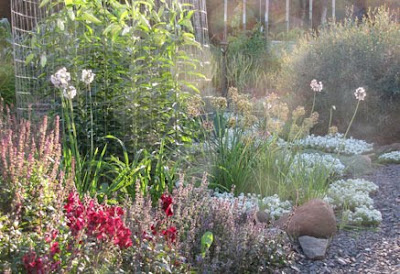 Casas caged for their own good.
2. An asiatic lily called 'Grand Cru' makes its statement in mid- to late July. No fragrance to speak of, but its color more than makes up for that. It's a nice companion for baptisia (the straight blue species.)
 The flowers aren't huge, but there are plenty of 'em.
 The poppies are an annual; the allium is a perennial. Both complement the mystery pink lily. That's campanula 'Pantaloons' on the right -- shortly before flowering.
1. These are Casa Blanca lilies, a garden classic. Beautiful clear white that only gets more lovely as the sun goes down. Graceful form. Nice fragrance. Tall, sturdy stems. Unfortunately, the deer also favor them. Last year, we didn't get any blooms because of the deer. This year, we doubled up on protection, caging them for much of the growing season and using the motion-detecting sprinkler to scare off would-be diners. The cage isn't the most attractive option, but you do tend to look past it because there are so many other things to see. These are the last of our lilies to bloom, making a grand statement in late August.
 Big, bodacious blooms and buds.
 Casas caged for their own good.
2. An asiatic lily called 'Grand Cru' makes its statement in mid- to late July. No fragrance to speak of, but its color more than makes up for that. It's a nice companion for baptisia (the straight blue species.)
 The flowers aren't huge, but there are plenty of 'em.
3. Sometimes you just roll with the punches. We ordered some 'Rodela' lilies (an LA hybrid, a cross between L. longiflorium and asiatic lilies) several years back. When they flowered, they looked like this instead. So not the wine red of 'Rodela.' Pretty, but not where they were planted. Relocated to the front of the house, they mix well with my favorite 'Lauren's Grape' poppies and pink allium. We're still not sure what variety they are, but they have found a home here anyway.
 The poppies are an annual; the allium is a perennial. Both complement the mystery pink lily. That's campanula 'Pantaloons' on the right -- shortly before flowering.
4. This is the 'Rodela' we were looking for. I love how the flowers are held upright like candelabra. It blooms in late July. Reputable plant purveyors want to make things right with their customers. When we alerted the folks at John Scheeper's about the lily mixup, they sent us the right ones.
 Give 'Rodela' some space so you can better appreciate its form.
 These lilies are growing in a bed with catmint and monkshood.
 These mystery lilies are especially winsome next to the variegated burnet. Deer nibbled the burnet in early summer, but it came back strong.
 Give 'Rodela' some space so you can better appreciate its form.
5. Many bulb merchants offer mixes where you can get more bulbs for less. It's a good way to go if you're looking to paint a scene with a broad brush rather than a specific color. These dark pink beauties are from such a mix that also included pale pink and white lilies.
 These lilies are growing in a bed with catmint and monkshood.
6. Here's yet another example of why it's important to tag things and keep records. These pale yellow lilies were a surprise in early August. No one here remembers planting them, but I sure do like them. If I only knew what they were, I could order more.
 These mystery lilies are especially winsome next to the variegated burnet. Deer nibbled the burnet in early summer, but it came back strong.
Subscribe to:
Posts (Atom)